


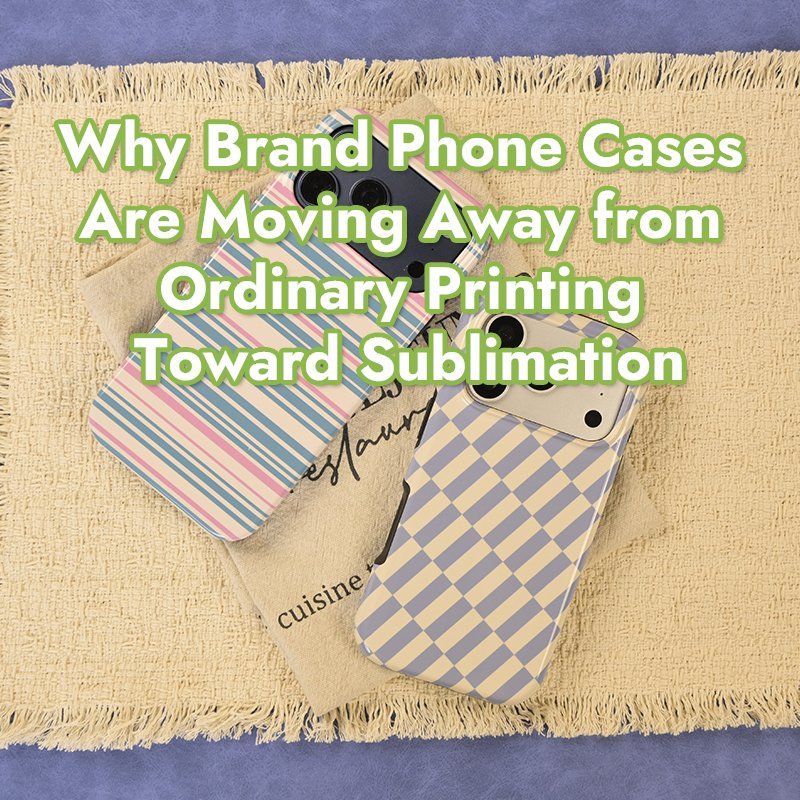
Phone cases are no longer just protective accessories. For a growing number of brands and users, they have become a form of emotional expression, personal style, and even brand extension. In recent years, a clear shift has been taking place: more and more brands are deliberately moving away from ordinary printing methods (UV printing, stickers, surface heat transfer, etc.) and adopting dye sublimation instead.
Why is this happening? Is it simply because sublimation “looks better,” or are there deeper commercial and user-driven reasons behind the change? Let’s break it down from the technology, user experience, and brand value perspectives.

Ordinary Printing vs. Sublimation: Two Fundamentally Different Approaches
First, the core difference needs to be clear.
Ordinary printing essentially “attaches” or “sprays” the design onto the surface of the case. The ink or film sits on top of the shell, creating a visible printed layer. Its advantages include relatively fast production speed, controllable costs, and suitability for large volume flat printing. The drawbacks, however, are equally clear: the design can easily be scratched, fade, or peel over time; full edge coverage is difficult to achieve; and the hand-feel often retains a slight “printed layer” sensation.
Sublimation works completely differently. It uses specially coated blanks, sublimation ink,sublimation film (or sublimation paper), and high temperature plus pressure (often with sublimation vacuum machine). The solid ink turns into gas and penetrates into the coating. Once cooled, the design becomes part of the case itself — not sitting on the surface, but integrated into it.
In short:
- Ordinary printing: the design floats on the surface
- Sublimation: the design penetrates at a molecular level and becomes part of the shell
This fundamental difference directly determines durability, tactile feel, visual quality, and brand positioning.

Why Brands Are Abandoning Ordinary Printing
This is not a temporary trend. It is the result of rising user expectations and market competition.
-
Durability has become a hard requirement
Phone cases face daily friction from pockets and surfaces, occasional drops, sunlight, sweat, and oils. With ordinary printing, fading, scratching, or edge peeling after a few months is common, leading to higher after-sales costs and negative reviews. Because sublimation ink penetrates the coating, peeling is virtually eliminated, and colors hold up better against UV exposure and everyday wear. For brands, this means lower support costs and stronger long-term customer trust.
-
Visual quality and hand–feel directly support higher pricing
Sublimation delivers photo realistic color reproduction and smooth gradients. Whether glossy or matte, the surface can feel close to factory original smoothness, with no raised ink layer. The first impression users get when holding the case is simply “premium.” In a highly homogenized phone case market, this combination of better looks and better feel has become a key differentiator that allows brands to command higher prices.

-
Full–wrap designs are becoming the expected standard
Most ordinary printing is limited to the flat back, often leaving the sides blank. Sublimation, especially when paired with film and vacuum transfer, can achieve true 360° coverage, with the design flowing naturally from the back onto the edges. For brands that care about visual completeness and cohesive design language, this is nearly essential.
-
From “having a design” to “the design becoming part of the case”
Younger users increasingly treat phone cases as emotional carriers. They want more than just “nice-looking” — they want something that holds up in daily use. Sublimation meets the triple demand of aesthetics, durability, and tactile quality, enabling brands to position products at a higher level and support better margins instead of competing purely on price in the ordinary printing space.
The supply chain has matured, making small-batch and custom work more flexible
Sublimation was once seen as slow and high-barrier. With the wider availability of quality coated blanks, high-transfer-rate sublimation films, and sublimation phone case machine, brands can now run small batches, launch new designs quickly, and even offer true on-demand customization. For brands focused on differentiation, this is often more strategically valuable than large-volume UV production.

Core Advantages of Sublimation Phone Cases and Best–Fit Scenarios
In summary, sublimation’s key strengths are:
- Resistance to fading, peeling, and scratching
- Vibrant, sharp, near photo-quality colors
- Completely smooth surface with a premium hand-feel
- Support for full-wrap designs
- Suitability for premium custom, brand collaborations, and personalized e-commerce

It is especially well-suited for:
- Phone case brands seeking differentiation
- E-commerce sellers who value repeat purchases and reputation
- Teams that need fast product launches and small-batch testing
- Gift or collaboration products with higher visual and tactile expectations
Of course, sublimation has its own characteristics: it places higher demands on blank coating quality and process control, and individual production cycles are typically slower than UV. What it delivers in return is stronger product pricing power and more consistent user experience.

How Brands Can Successfully Transition to Sublimation
If you are considering moving from ordinary printing to sublimation, here are practical steps:
- Choose the right blanks
Prioritize suppliers with mature coatings, anti-yellowing-performance, consistent hand-feel, and broad model coverage. Coating quality directly determines final transfer results and durability.

- Match the process and equipment
2D flat presses work well for flat designs; 3D vacuum systems with film are better for full-wrap results. Equipment and consumables must be properly matched.
- Control quality consistency
Color calibration, batch stability, and durability testing should be established early to avoid large-scale issues later.
- Start with core models
Begin with a few high-demand models and small design batches to test market response before scaling.
Having support from mold development and injection molding through coating, blank supply, and technical guidance significantly reduces trial-and-error costs.

Conclusion
Ordinary printing solves the problem of “having a design.” Sublimation solves the problem of “the design truly becoming part of the case.” This is not merely a process upgrade — it is a natural response to rising user expectations around quality, feel, and long-term performance.
As more brands begin treating phone cases as long-term emotional products rather than disposable accessories, the advantages of sublimation become increasingly clear. It makes products more durable, more premium, and more brand worthy.
We have specialized in sublimation blanks and related consumables for many years and can provide one-stop support ranging from standard stock to fully custom development. Feel free to reach out anytime with questions.

