


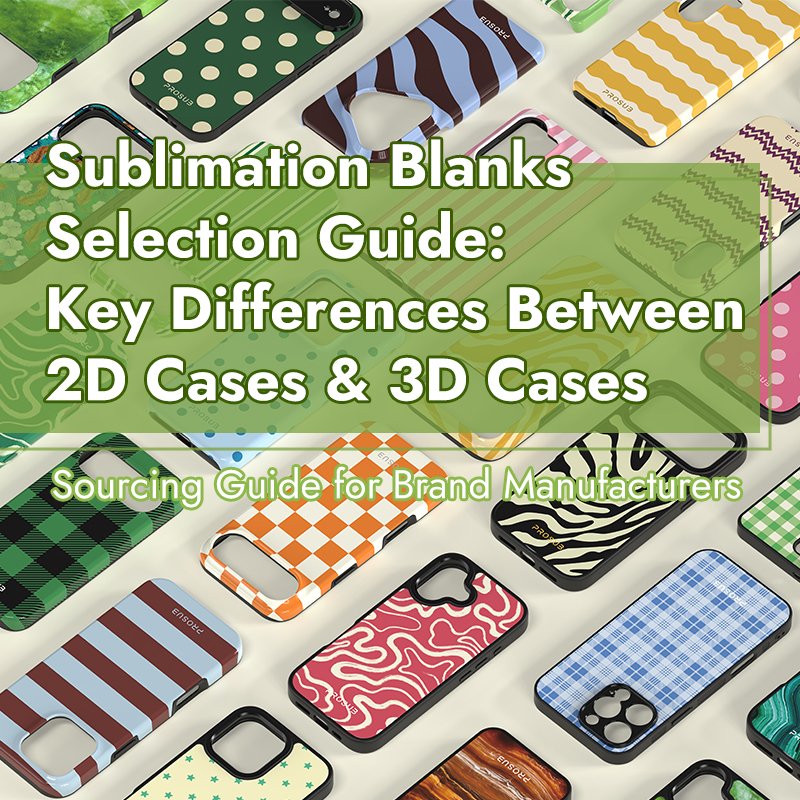
As personalized customization and on-demand manufacturing continue to boom, blank sublimation phone cases and digital accessories have become hot-selling supply items on Amazon, independent websites and e-commerce studios. How can buyers select suitable blank phone case consumables based on their target customer groups and existing equipment configurations?
This article breaks down the differences in base materials, craftsmanship and supporting consumables between two types of phone cases, helping overseas wholesalers, brand manufacturers and cross-border sellers make precise product selections.

What Are 2D Phone Cases and 3D Phone Cases?
As the name suggests, 2D phone cases feature a flat shell structure. Printing can only be applied to the flat rear area of the phone case, while curved edges on the sides cannot be transferred. Prosub supplies two material variants of 2D cases: TPU+PC with aluminum sheet backplate, and TPU+PC with glass backplate.

-
Special Vacuum Sublimation Blanks for 3D Cases
3D cases support full-surface curved printing and require vacuum heat transfer machines for transfer printing, enabling full wrapping printing on both the back and side edges. The shells are made of PBT material or PC material coated with a special functional layer.
- 3D PBT coated cases
- 3D coated cases

Six Core Differences Between 2D Cases and 3D Cases
-
Printing Coverage: Flat Surface vs. Full Curved Wrap
- 2D flat blanks: Printing is limited to the flat rear panel of the case; side edges and curved corners remain blank after production.
- 3D vacuum blanks: Driven by vacuum negative pressure fitting, patterns are fully transferred across the back panel, side edges and camera arcs, delivering full coverage without blank margins.

-
Incompatible Matching Equipment
- 2D cases: Compatible with standard flat heat presses that apply vertical flat pressure for transfer printing.

- 3D cases: Mandatory use of sublimation vacuum High temperature and pressure wrap around the curved shell for full-wrap printing; flat presses cannot achieve full-edge coverage.

-
Non-Interchangeable Supporting Transfer Consumables
- 2D cases: Only standard sublimation paper is required, with no stretching tolerance requirements for the paper.

- 3D cases: The stretching process of curved surfaces demands high ductility from the carrier film. Special sublimation film must be used; standard sublimation transfer film will wrinkle and turn white during printing.

-
Differences in Shell Coating and Base Materials
- 2D cases: Constructed with TPU+PC plus an aluminum or glass backplate, with the aluminum or glass sheet serving as the printing substrate.

- 3D cases: Generally manufactured from PBT material or PC base material sprayed with a special functional coating.

-
Tiered Procurement Costs and Retail Price Points
- 2D cases feature affordable raw materials and standard transfer paper, with low unit sourcing prices, ideal for high-volume, low-margin sales strategies.
- 3D cases incur higher costs due to complex base material structures, functional coatings and PET film. Finished products carry higher price premiums with ample profit margins.
-
Segmented Target Overseas Customer Groups
- 2D cases suit low-budget general goods vendors: unbranded e-commerce sellers, offline discount accessory stores and entry-level studios. Their customers prioritize cost performance and have no strict requirements for full printing coverage.
- 3D cases target high-end customization clients (especially premium 3D coated cases): large brand manufacturers, corporate gift customization firms, event cultural merchandise and trendy custom accessory shops. These customers are willing to pay higher prices for fully wrapped, high-quality finished products.

Functional Performance Comparison: Drop Resistance, Scratch Resistance and Color Durability
Performance Test of 2D Cases
- Glass backplate variants of 2D cases deliver superior durability, while aluminum sheet backplates show obvious scratches under heavy abrasion. Both versions feature strong color adhesion with excellent fade resistance, and the flat structure resists deformation well. They offer outstanding cost performance at a low price point.
- The soft TPU side borders of 2D cases provide effective cushioning during drops, and the rigid PC backplate delivers reliable protection for the phone frame and rear panel.

Performance Test of 3D Cases
- 3D cases feature rigid, stiff construction that fits the phone snugly without excessive bulk. They boast noticeably better scratch resistance than 2D cases, and coated 3D cases come with micro-scratch self-repair functionality for long-lasting service life. Patterns adhere firmly and resist fading.
- Single-layer 3D hard shells have rigid base materials with strong structural support and minimal deformation, yet provide weak shock absorption and drop protection. Pairing a single hard shell with an inner TPU liner drastically improves shock resistance, reaching military-grade drop protection standards for comprehensive device safety.

How to Source Premium Sublimation Consumable Suppliers
Prosub is a well-known wholesale supplier of sublimation phone case blanks in the industry. We stock full series blank sublimation phone cases compatible with mainstream mobile phone models and a complete lineup of digital accessory supplies.

We also offer custom graphic printing services, single-piece sample production and mass production supporting solutions. If you require wholesale blank sublimation consumables or OEM customization cooperation, feel free to contact us for samples and customized supply packages.

